“I am not an artist. Why am I not? What does an artist do?”
This was the opening sentence of one of my journal entries in 2014. Reflecting on that time now, I realize how much I doubted my abilities. I had begun to neglect and even despise my artistic inclinations. But why? Why would anyone decide to stop drawing and erase all traces?
I began drawing as a child. My aptitude for it was evident to my father, who had also developed this skill at an early age. He would talk to me about observing and understanding light and shadow. I must have been around eight years old at the time. I remember such interactions because they sparked my interest and curiosity. As a result, I continued and developed the ability to copy what I saw. I would spend hours focused trying to draw as precisely as possible.
As I grew older, I began to doubt my abilities. I felt inadequate for not having received any formal instruction. During my teenage years, drawing stopped being fun; it became a forced activity where I just needed to keep improving. My drawings never seemed “good enough.” Without guidance, community, and support, improving was a difficult task to achieve. It was evident that I was not enjoying the journey.
Despite receiving positive feedback about my talent, I continued to dismiss those opinions with disbelief. I simply did not believe in my abilities or in my capacity to improve. Growing up as an immigrant also strengthened my insecurities and constant feelings of inadequacy. Although I still aspired to become a fine artist during high school, all my dreams vanished when I had to choose a more “practical” career. As an immigrant facing financial difficulties, my aspiration to study fine arts became a fantasy—a fleeting dream that I concealed. I simply could not afford it.
In 2014, while working as a graphic designer, it became clear to me that I would not dedicate my time to drawing. Nor would I focus on improving in that medium. I wanted to avoid art and everything that reminded me of my emotional sensitivity. I was irritated, but more than anything, I was deeply sad.
Ten years passed—ten years of neglect—when suddenly an intense urge to draw arose. Why now? What had changed? Me. I had changed my perspective. I had been healing the part of me that hindered my progress. Naturally, I could no longer neglect my passion, which had now become compassion. In 2024, I gathered my enthusiasm and started learning about charcoal drawing techniques. I reconnected immediately. Since then, I have been prioritizing my learning and practice. I am glad to have gained a gentler perspective, which has allowed me to resume my artistic journey with renewed joy.
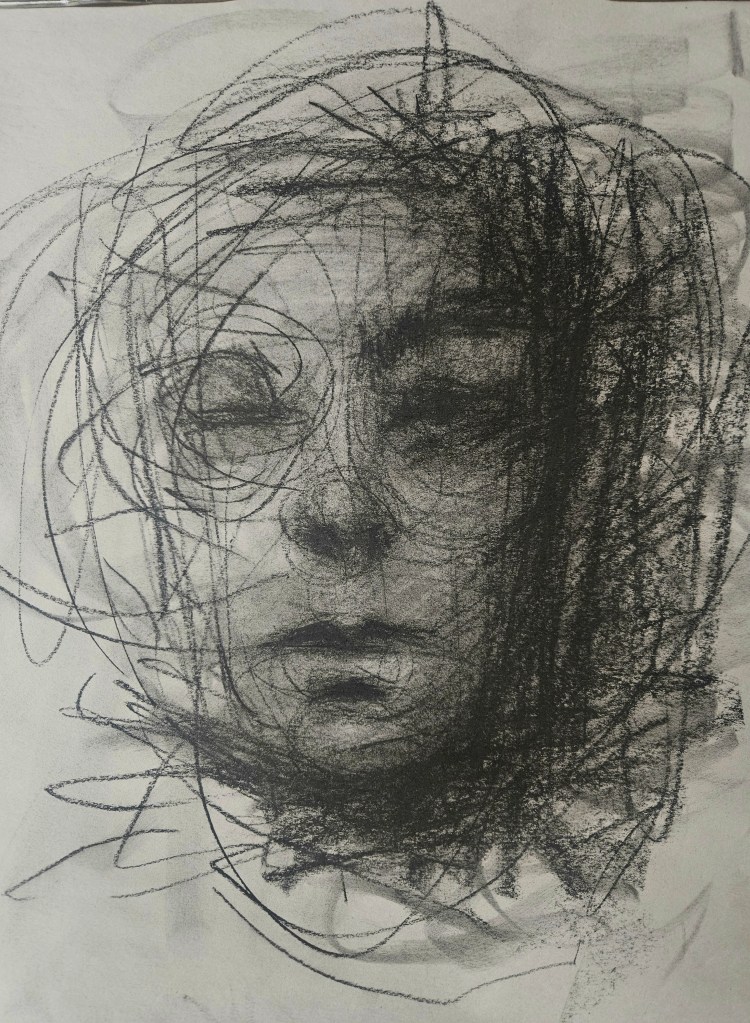
“Sometimes I don’t want to care, but I care so much that I become paralyzed. I think I should be more honest with myself.”
— Journal entry from 2014
 Asolas Studio
Leave a comment